Longest Increasing Subsequence
Read at your own pace. Code execution, quizzes, progress tracking, and the AI tutor are available in the interactive view with JavaScript enabled.
Description
The Longest Increasing Subsequence (LIS) is a subsequence within an array of numbers with an increasing order. The numbers within the subsequence have to be unique and in an ascending manner. It's important to note that the items of the sequence do not have to be in consecutive locations within the array.
Can you write an efficient program that finds the length of Longest Increasing Subsequence, also called LIS?

Examples
Here are some examples and their solutions:
Input: {1,5,2,7,3}
LIS = 3.  The longest increasing subsequence could be any of {1,5,7},{1,2,3},{1,2,7}

Input: {13,1,3,4,8,4}
LIS = 4.  The longest increasing subsequence {1,3,4,8}

Input: {13,1,3,4,8,19,17,8,0,20,14}
LIS = 6.  The longest increasing subsequence {1,3,4,8,17,20},{1,3,4,8,19,20}
Constraints
- Length of the given array <=
100000 - The array will always contain integer values between
-1000000000and1000000000 - Expected time complexity :
O(nlogn) - Expected space complexity :
O(n)
How to Solve LIS
How to Solve LIS
In this tutorial, I'll refer to the longest increasing subsequence as LIS. Let's first explore a simple recursive technique that can find the LIS for an array. We'll use the following notation to explain:
Suppose we have a function LIS(arr, n). Let this function reflect the length of the longest increasing sub-sequence that has arr[n] as "its last element".
We'll build on this function shortly. With this, let's look at the examples below. Here, all the subsequence indices start from zero. We're just exploring some patterns for now:
// in the below example, we're looking for arr[0], which is 1
LIS({1,3,4,0}, 0) = 1        // the solution is the simple subsequence {1}

// continuing the pattern
// here we're looking for a subsequence ending in arr[1]
LIS({1,3,4,0}, 1) = 2        // the subsequence {1,3} w/ length 2
// further continuing..
LIS({1,3,4,0}, 2) = 3        // the subsequence {1,3,4} w/ length 3
LIS({1,3,4,0}, 3) = 1        // the subsequence {0} as it has to include arr[3]
Some observations emerge as we go through this exercise: as the subsequence has to end in arr[n], it can only include elements that satisfy two conditions:
- The elements need to be at an index smaller than
n. - The elements themselves must be smaller than
arr[n]to fit the "increasing subsequence" condition.
We can thus derive the following rule from our observations:
LIS(arr, n) = 1 + max( LIS(arr, j) ) max computed over all j, 0<=j<n and arr[j]<arr[n]
We can translate this into plain English: if we can find LIS(arr, n) (the LIS with arr[n] as its last element) for all indices of the array, then the longest increasing subsequence for the entire array LISMax(arr) would be the maximum of all the LIS(arr, n), computed for all valid indices n:
LISMax(arr) = max( LIS(arr, n) ) max computed for all valid indices n of the array
0Pseudo-Code
Pseudo-Code
Now that we have a simple rule to solve the problem, let's write the pseudo-code for it. We've essentially broken the larger problem into subproblems (figuring out the LIS(arr, n) for multiple ns).
Routine: LISMax(arr)
Input: array of size S
Output: Length of longest increasing subsequence

LISMax(arr)

1. max = 0
2. Loop from n = 0..(S-1)
    a. Compute temp = LIS(arr, n)
    b. if temp > max then max = temp
return max
Alternatively, the pseudo-code for computing LIS with two parameters is given below:
Routine: LIS(arr, n)
Input: array of size S and index n
Output: Length of longest increasing subsequence that has arr[n] as its last item

LIS(arr, n)

Base case:
1. if (n==0) return 1

Recursive case:
1. max = 1
2. Loop from j=0..(n-1)
    a. if (arr[j]<arr[n])
            i. compute temp = LIS(arr, j)
            ii. if (temp>max) then max=temp
return max
To understand how this pseudo-code works, here's an an example of LIS computation for {2, 3, 8, 5, 6} for index 4. At index 4 is the number 6, and thus, the subsequence has to include the number 6 as its last item.
In the below visual, we seek any numbers smaller than 6 to see if there is a potential increasing subsequence there. Follow the logic from top to bottom, and you'll see we find the solution from prior solutions, in a surprisingly similar manner to Fibonacci Sequence.
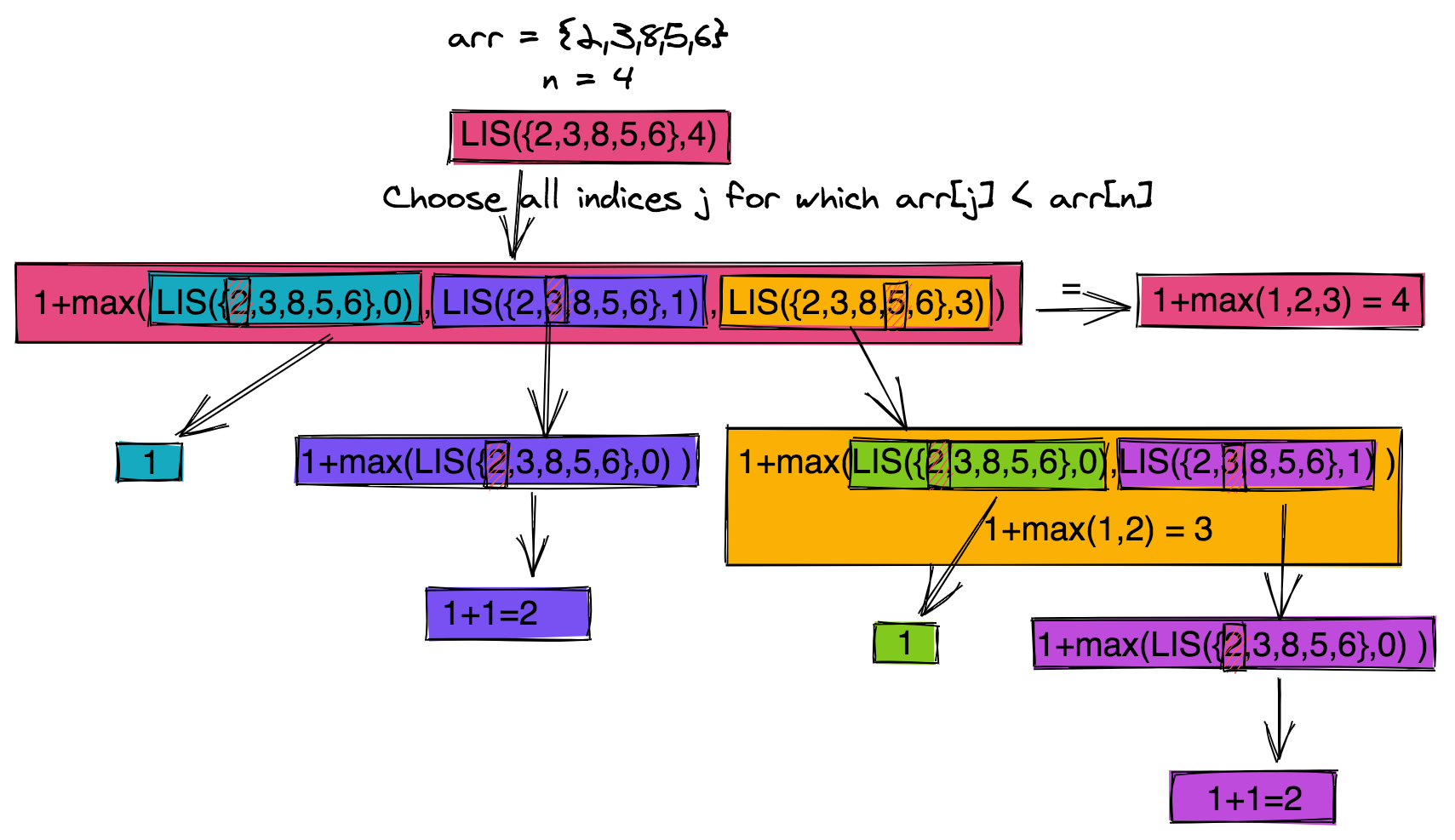
The figure shows that LIS(arr, 0) needs to be computed again and again. The same is the case for LIS(arr, 1). For larger values of n, there will be many values for which the function has to be repeated. This would lead to a time complexity of O(2^n), which is exponential. As computer scientists, we know that it is not a practical solution.
0Dynamic Programming to the Rescue
Dynamic Programming to the Rescue
The basic principle behind dynamic programming is that if your solution has a recursive structure, then you can:
- Break down the problem into smaller repeating sub-problems.
- Store the solutions of the sub-problems and use them later when needed
For example, LIS(arr, 0) and LIS(arr, 1) are re-calculated and required again and again. Alternatively, once computed, we can store them in an array, and use this result whenever it is needed.
Hence, now we have to account for an additional array. Let's call this array LISArr, which stores the value of LIS(arr, n) at index n.
- Initialize each element of
LISArrto zero. - If
LIS(arr, n)is required, then check the value ofLISArr[n].- If LISArr[n] is zero, then compute LIS(arr,n) and store in LISArr[n]
- If LISArr[n] is greater than zero, then simply use its value from the array.
Now it is time to change the prior pseudo-code to incorporate dynamic programming. Only the LIS(arr, n) routine needs to be changed, with one additional parameter to include the array LISArr.
We can see that the time complexity of this pseudo-code is still quadratic, i.e., O(n^2). The LISDP function runs for each item of the array and for each item, LIS runs at the most n times. This makes the overall complexity O(n^2).
```
Routine: LISDP(arr,n,LISArr)
Input: an array of size S and index n, length array same size as arr and initialized to zero
Output: Length of longest increasing subsequence that has arr[n] as its last item

LISDP(arr,n,LISArr)

Base case:
1. if (n==0) return 1
2. if LISArr[n] != 0 return LISArr[n]  //do not go in the recursive case

Recursive case:
1. max = 1
2. Loop from j=0..(n-1)
    a. if (arr[j]<arr[n])
        i.   LISArr[j] = LISDP(arr,j,LISArr) //compute LIS(arr,j)
        ii. if (LISArr[j] > max) then max = LISArr[j]
return max
```
Solution for DP
Code for LIS using Dynamic Programming
Finally, here's the code for implementing LIS using dynamic programming in a few different languages. As always, we advise you to work everything out on a piece of paper before implementing anything.
```cpp
#include <stdio.h>
#include <iostream>
#include <vector>
using namespace std;

class LISsolveDP
{
    //recursive function to return LIS(arr,n) as described
    int LISDP(vector<int> arr,int ind,vector<int> & LISArr)
    {
        int i=0;
        if (LISArr[ind] !=0)
            return LISArr[ind];
        if (ind == 0)
        {
            LISArr[ind]=1;
            return 1;
        }
        int temp=0,max=1;

        for (i=0;i<ind;++i)
        {
            temp = LISArr[i];
            if (temp==0)
                temp = LISDP(arr,i,LISArr);
            if (arr[i]<arr[ind])
                temp++;
            if (temp>max&&arr[i]<arr[ind])
            {
                max = temp;
                //uncomment below to understand
                //cout << "...ind = " << ind<< " i=" << i << " max= " << max << "\n";
            }
        }
        LISArr[ind] = max;
        return max;
    }

public:
    int LIS(vector<int> arr)
    {
        int result = 0,temp=0;
        //initialize LISArr
        vector<int> LISArr(arr.size(),0);

        for (int i=0;i<arr.size();++i)
        {
            temp = LISDP(arr,i,LISArr);
            if (temp>result)
                result = temp;
        }
        return result;
    }
};

class LISsolveFast
{
    //temporary array that stores the index of all end elements
    //the zeroth index won't be used as the index of LISArr represents
    //the length of the longest subsequence
    vector<int>LISArr;
    int lastIndex;
    //return the index of the array where item can be placed
    //first is the index where to start
    //last is the index where to end
    int binarySearchIndices(vector<int> arr,int item)
    {
        //check the boundaries first
        if (item < arr[LISArr[1]])
            return 1;
        if (item > arr[LISArr[lastIndex]])
            return lastIndex+1;

        int first = 1;          //index
        int last = lastIndex;   //index
        int mid = (first+last)/2;
        bool found = false;
        while (!found && first<=last)
        {

            cout.flush();
            if (item<arr[LISArr[mid]])
                last = mid-1;
            else if(item>arr[LISArr[mid]])
                first = mid+1;
            else found = true;
            mid = (first+last)/2;

        }
        if (item>arr[LISArr[mid]])
            mid = mid+1;
        return mid;


    }
public:
//function implements the (nlog n) solution
    int LIS(vector<int> arr)
    {
        int i,ind;
        //handle an exception first thing
        if (arr.size()==0)
            return 0;

        LISArr.resize(arr.size()+1,0);
        LISArr[1] = 0;                 //arr[0] is subsequence of length 1
        lastIndex = 1;                 //this is the index of the longet sequence found so far
        for (i=1;i<arr.size();++i)
        {
            ind = binarySearchIndices(arr,arr[i]);
            LISArr[ind] = i;
            if (ind>lastIndex)      //inserting at end
                lastIndex = ind;
        }
        return lastIndex;           //this is LIS
    }
};
int main()
{
    int arr[] = {5, 15 ,8, 7, 4, 10, 20, 19, 7, 25, 29, 11 };
    vector <int> myArray(sizeof(arr)/sizeof(arr[0]),0);
    for (int i=0;i<myArray.size();++i)
    {
        myArray[i] = arr[i];
    }
    LISsolveDP lisDP;
    LISsolveFast lisFast;
    int result = lisDP.LIS(myArray);
    cout << "\n *** result from DP = " << result << "\n";

    result = lisFast.LIS(myArray);
    cout << "\n *** result from fast method = " << result << "\n";

}
```
```js
// Dynamic programming solution
const longestIncreasingSubsequence = function (nums) {
  // Create an array to memoize
  const dpMemo = Array.from(nums, () => 1);
  // Initialize subsequence length
  let max = 1;
  // Check all increasing subsequences up to the current ith number in nums
  for (let i = 1; i < nums.length; i++) {
    // Keep track of subsequence length in the dpMemo array
    for (let j = 0; j < i; j++) {
      // Only change dpMemo value if the numbers are increasing
      if (nums[i] > nums[j]) {
        // Set the value to be the larget subsequence length
        dpMemo[i] = Math.max(dpMemo[i], dpMemo[j] + 1);
        // Check if this subsequence is the largest
        max = Math.max(dpMemo[i], max);
      }
    }
  }
  return max;
};

const result = longestIncreasingSubsequence([
  5, 15, 8, 7, 4, 10, 20, 19, 7, 25, 29, 11,
]);
console.log(result);
```
```py
# Dynamic programming solution
def longestIncreasingSubsequence(nums):
  # Create an array to memoize
  dpMemo = [1] * len(nums)
  # Initialize subsequence length
  maximum = 1
  # Check all increasing subsequences up to the current ith number in nums
  for i in range (1, len(nums)):
      # Keep track of subsequence length in the dpMemo array
        for j in range(0, i):
            # Only change dpMemo value if the numbers are increasing
            if nums[i] > nums[j] and dpMemo[i]< dpMemo[j] + 1:
                # Set the value to be the larget subsequence length
                dpMemo[i] = dpMemo[j]+1
                # Check if this subsequence is the largest
                maximum = max(dpMemo[i], maximum)
  return maximum

result = longestIncreasingSubsequence([
  5, 15, 8, 7, 4, 10, 20, 19, 7, 25, 29, 11,
])
print(result)
```
An Efficient Algorithm for Running LIS
An Efficient Algorithm for Running LIS
LIS using dynamic programming still requires O(n^2) computations. Can you find an improved algorithm that uses O(n log n) time?
To understand how the solution of finding LIS can be made more efficient, let's review binary search first. We can improve upon the computation time by making use of the fact that it takes O(log n) time to search for an item in a sorted array when using binary search.
Coming back to finding LIS-- we'll use an intermediate array again called LISArray. Let us define its purpose in this instance, and highlight a few important points:
We will use
LISArrayto store indices of the input arrayarr.We'll also use
LISArrayto keep track of the longest subsequence found so far.LISArray[j]:LISArray[j]will map to the index of the smallest item ofarrthat's the last item for a subsequence of length j.arr[LISArray[j]]: Ending element of subsequence of lengthj.Size of LISArray[j] = (Size of arr)+ 1, asLISArr[j]has information on subsequence of length j, indices start at zero so we need an additional element to store the maximum possible length.LISArray[0]is unused.Maximum index of LISArray can be at
(Size of arr).
0Purpose of the Array
Purpose of the Array
Once we understand the purpose of the array LISArray, the algorithm itself is pretty easy to understand. In the examples below, LISArray's indices are a result from scanning the entire input arr. Note that at index j, it is storing the result of the smallest element in the entire array that occurs at the end of a subsequence of length j.
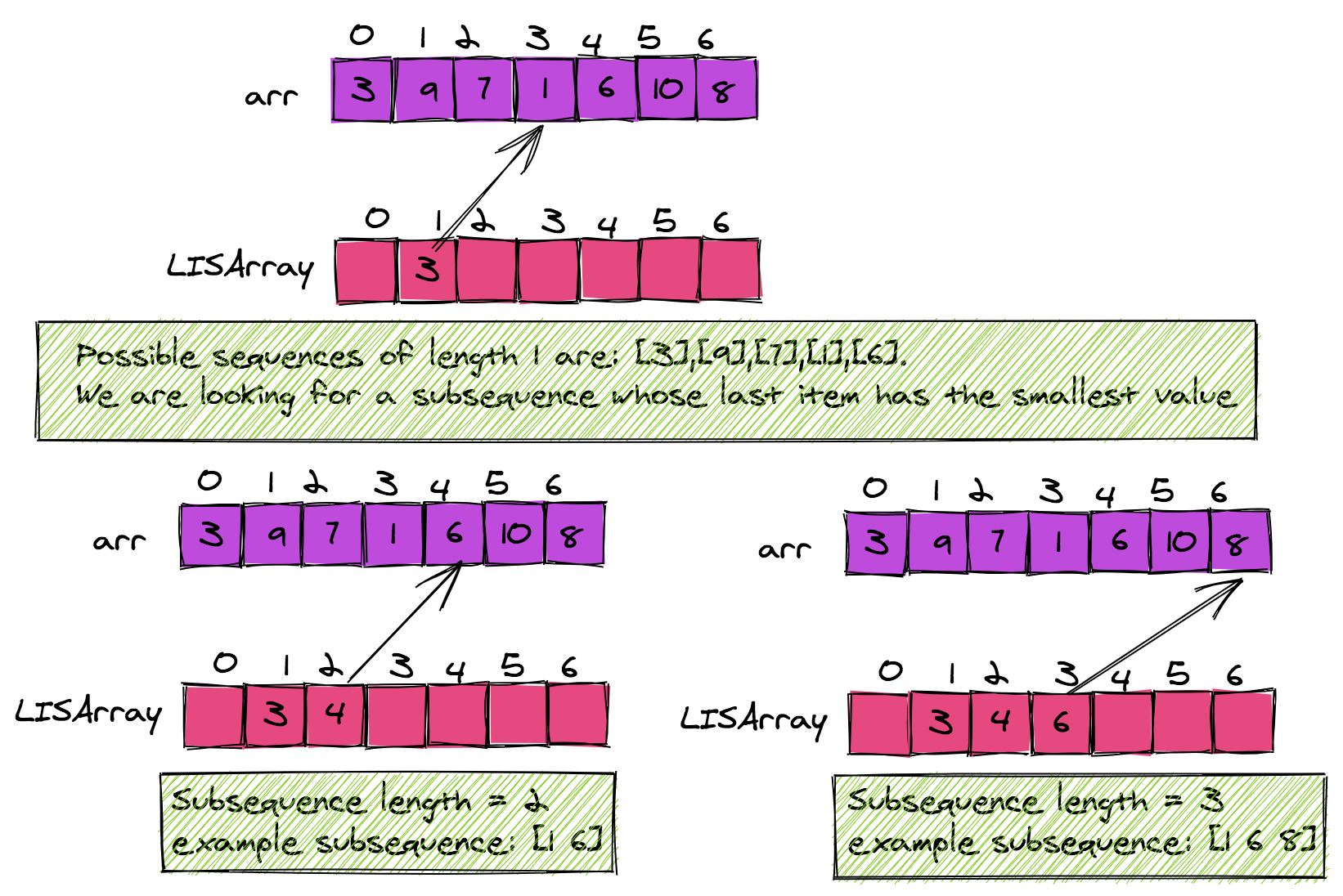
This is interesting because note the following;
LISArray: {3, 4, 8}
arr[LISArray[i]] = 1, 6, 8     // (for i=1..2)
So the important point to note is that LISArray stores the indices of the items of input array in sorted order!
Hence the following is true:
    arr[LISArray[1]] < arr[LISArray[2]] < arr[LISArray[3]] < arr[LISArray[4]] ...
    arr[LISArray[j]] < arr[LISArray[j+1]]
Ready for Pseudo-Code
Ready for Pseudo-Code
Armed with this knowledge, we are ready to construct the pseudo-code for an algorithm that solves LIS efficiently.
All we need to do is scan the items of arr one by one, and find their place in LISArray. Because LISArray stores the indices of items of the input array in sorted order, we can use binary search to find the place of arr[i] in LISArray.
The example below shows how LISArray is filled out one by one, when given an element of arr. We also need to keep track of the last filled index of LISArray. We only add a new item to LISArray when the next item of arr is higher than all items that were previously added.
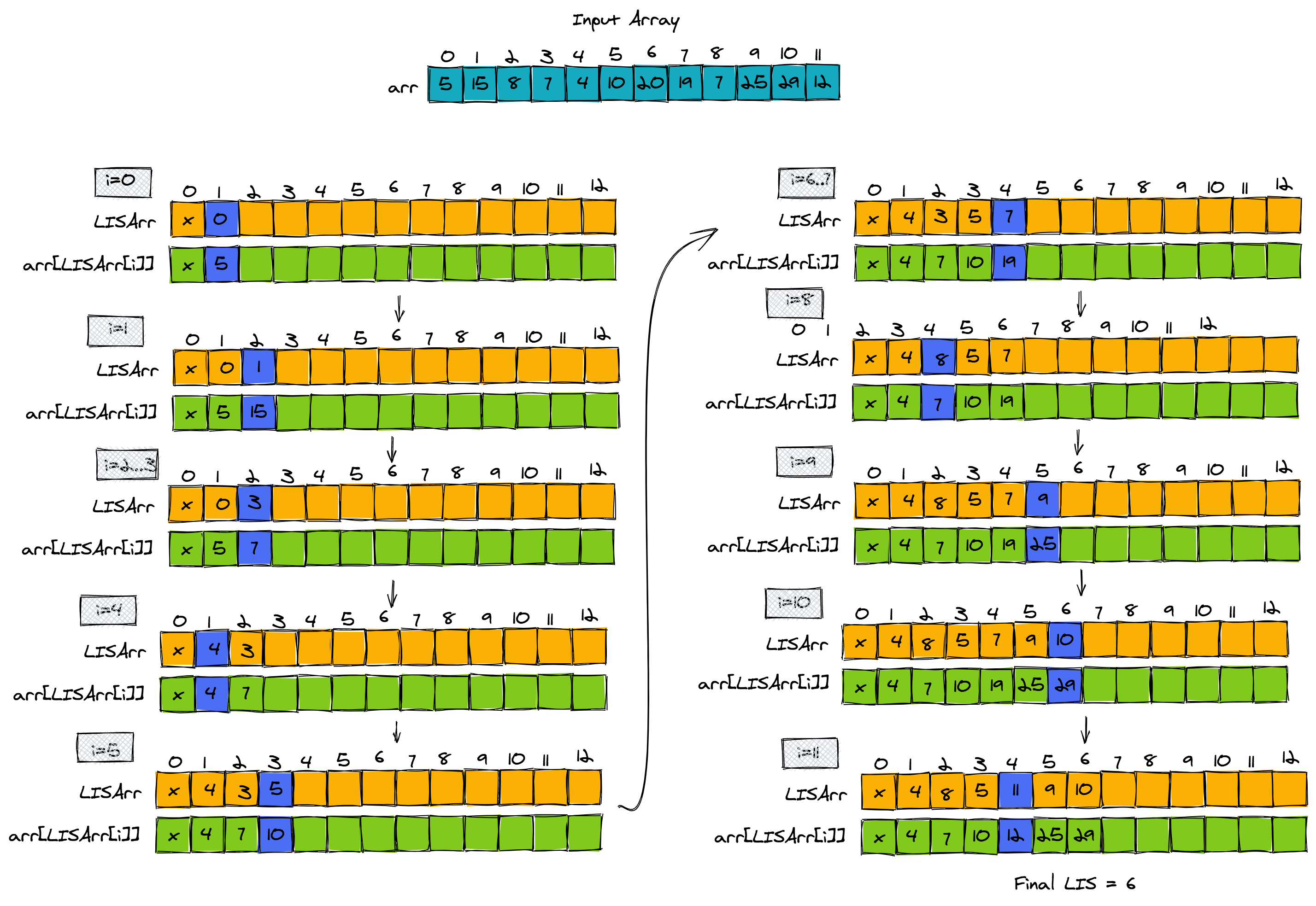
The final pseudo-code is given below. Note that the algorithm goes through each item of arr exactly once (n items scanned once) and finds their place in LISArray using binary search (O(log n) time). Hence the overall time complexity of this algorithm is O(n log n).
Routine: LISFast
Input: arr of length n
Output: Largest increasing subsequence within arr
Intermediate storage: LISArray of size (n+1), initialized to zero

1. lastIndex = 1
2. LISArr[lastIndex] = 0
3. for i=1..n
    a. ind = binary search for index position in LISArr for arr[i]
    b. LISArr[ind] = i
    c. if (ind > lastIndex)
        lastIndex = ind
4. return lastIndex
You can now write efficient code for finding LIS in O(n log(n)) time using the examples and pseudo-code.
Getting the sequence along with the length
Ever wondered how you can get the actual sequence from the given array? We can do this easily by using another array. Try to edit the above solution and solve this one. Finally, see the solution attached.
```python
def getLIS(nums):
    # Check if the sequence is empty
    if not nums:
        return nums

    M = [None] * len(nums)
    P = [None] * len(nums)

    # We know that there is at least an increasing subsequence of length one
    # which is the first element
    L = 1
    M[0] = 0

    # So we try to increase the length L from second item.
    for i in range(1, len(nums)):
        # We do a binary search just like the previous solution
        left = 0
        right = L

        # Check the right bound
        if nums[M[right-1]] < nums[i]:
            j = right
        else:
            while right - left > 1:
                mid = (right + left) // 2
                if nums[M[mid-1]] < nums[i]:
                    left = mid
                else:
                    right = mid

            j = left

        P[i] = M[j-1]

        if j == L or nums[i] < nums[M[j]]:
            M[j] = i
            L = max(L, j+1)

    # Now we need to get the sequence of length L
    # The result will be inversed
    seq = []
    i = M[L-1]
    for _ in range(L):
        seq.append(nums[i])
        i = P[i]

    return seq[::-1]

print(getLIS([5, 1, 8, 10, 5, 2, 14, 17, 19, 7, 9, 29]))
```
```js
function getLIS(nums) {
  // Check if the sequence is empty
  if (!nums) {
    return nums;
  }

  const M = [];
  const P = [];

  // We know that there is at least an increasing subsequence of length one
  // which is the first element
  let L = 1;
  M[0] = 0;

  // So we try to increase the length L from second item.
  for (let i = 1; i < nums.length; i++) {
    // We do a binary search just like the previous solution
    let left = 0;
    let right = L;

    // Check the right bound
    if (nums[M[right - 1]] < nums[i]) {
      j = right;
    } else {
      while (right - left > 1) {
        mid = Math.floor((right + left) / 2);
        if (nums[M[mid - 1]] < nums[i]) {
          left = mid;
        } else {
          right = mid;
        }
      }

      j = left;
    }

    P[i] = M[j - 1];

    if (j == L || nums[i] < nums[M[j]]) {
      M[j] = i;
      L = Math.max(L, j + 1);
    }
  }

  // Now we need to get the sequence of length L
  // The result will be inversed
  let seq = [];
  let i = M[L - 1];
  for (let j = 0; j < L; j++) {
    seq.push(nums[i]);
    i = P[i];
  }

  return seq.reverse();
}

console.log(getLIS([5, 1, 8, 10, 5, 2, 14, 17, 19, 7, 9, 29]));

```
One Pager Cheat Sheet
One Pager Cheat Sheet
- An efficient program that can find the length of the
Longest Increasing Subsequence (LIS)should satisfy the constraints ofO(nlogn)time complexity andO(n)space complexity. - We can use a recursive algorithm to compute the length of the
LISfor an array, which is the maximum ofLIS(arr, n)for all the valid indicesnof the array. - A
pseudo-codeis written to compute the Length of Longest Increasing Subsequence in anarrayusingrecursive casesandbase cases, which helps to reduce the time complexity to O(2^n). - Dynamic Programming can be used to break down a problem into smaller repeating sub-problems and significantly reduce the time complexity from
O(n^2)toO(n)by storing the solutions of the sub-problems and using them later when needed. Implementing Longest Increasing Subsequence (LIS) using Dynamic Programming may be accomplished by following the steps outlined and working through examples on paper, before coding it in any language.- LISArray stores the indices of the items of the input array in sorted order, allowing for the comparison of elements at specified indices in the original array.
- Armed with this knowledge, we are now ready to construct an
O(n log n)algorithm for solving LIS efficiently.