Merge Sorted Linked Lists
Read at your own pace. Code execution, quizzes, progress tracking, and the AI tutor are available in the interactive view with JavaScript enabled.
Description
Write an algorithm to merge two sorted linked lists and return it as a new sorted list. The new list should be constructed by joining the nodes of the input lists.
You may assume the following node definition:
function Node(val) {
  this.value = val;
  this.next = null;
}

const list1 = new Node(1);
list1.next = new Node(2);

console.log(list1);
public class Node {
    int value;
    Node next;

    Node(int value) {
        this.value = value;
        this.next = null;
    }

    public static void main(String[] args) {
        Node list1 = new Node(1);
        list1.next = new Node(2);

        System.out.println(list1.value + " -> " + list1.next.value);
    }
}
class Node:
    def __init__(self, val):
        self.value = val
        self.next = None

list1 = Node(1)
list1.next = Node(2)

print(list1.value, '->', list1.next.value)
#include<iostream>

struct Node {
    int value;
    Node* next;

    Node(int val) : value(val), next(nullptr) {}
};

int main() {
    Node* list1 = new Node(1);
    list1->next = new Node(2);

    std::cout << list1->value << " -> " << list1->next->value << std::endl;
}
public class Node {
    public int value;
    public Node next;

    public Node(int val) {
        this.value = val;
        this.next = null;
    }
}

class Program {
    static void Main() {
        Node list1 = new Node(1);
        list1.next = new Node(2);

        Console.WriteLine("{0} -> {1}", list1.value, list1.next.value);
    }
}
type Node struct {
    value int
    next *Node
}

func newNode(val int) *Node {
    return &Node{value: val}
}

func main() {
    list1 := newNode(1)
    list1.next = newNode(2)

    fmt.Printf("%d -> %d", list1.value, list1.next.value)
}
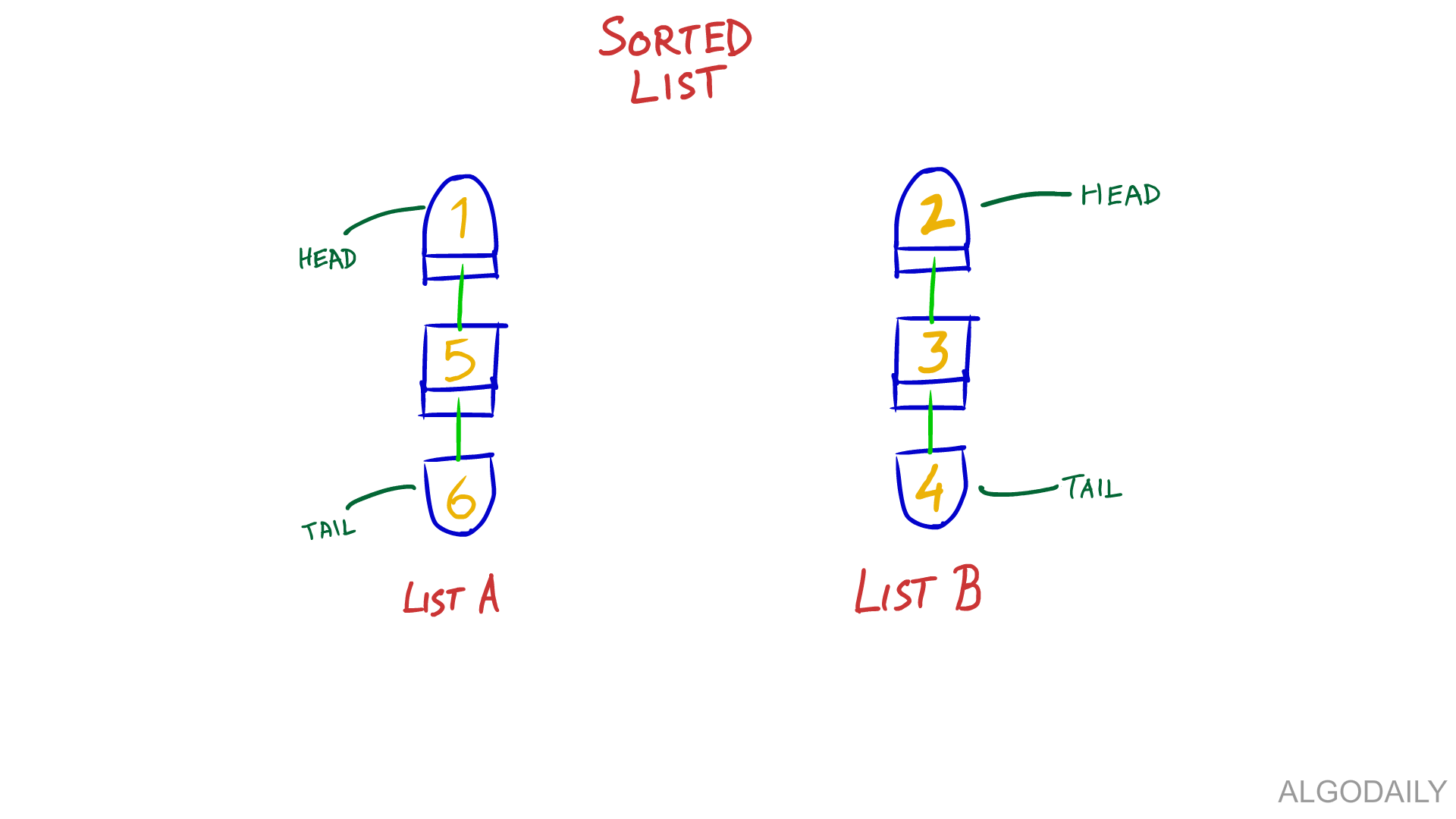
Write a method called mergeSortedLists that would be invoked as such in the following example:
// List 1: 1 -> 5 -> 6
// List 2: 2 -> 3 -> 4

mergeSortedLists(list1, list2);
// Output: 1 -> 2 -> 3 -> 4 -> 5 -> 6
// List 1: LinkedList<Integer> list1 = new LinkedList<>(Arrays.asList(1,5,6));
// List 2: LinkedList<Integer> list2 = new LinkedList<>(Arrays.asList(2,3,4));

LinkedList<Integer> mergedList = mergeSortedLists(list1, list2);
// Output: 1 -> 2 -> 3 -> 4 -> 5 -> 6
// List 1: std::list<int> list1 = {1, 5, 6};
// List 2: std::list<int> list2 = {2, 3, 4};

std::list<int> mergedList = mergeSortedLists(list1, list2);
// Output: 1 -> 2 -> 3 -> 4 -> 5 -> 6
# List 1: list1 = [1, 5, 6]
# List 2: list2 = [2, 3, 4]

merged_list = merge_sorted_lists(list1, list2)
# Output: [1, 2, 3, 4, 5, 6]
// List 1: List<int> list1 = new List<int> { 1, 5, 6 };
// List 2: List<int> list2 = new List<int> { 2, 3, 4 };

List<int> mergedList = MergeSortedLists(list1, list2);
// Output: 1 -> 2 -> 3 -> 4 -> 5 -> 6
// List 1: list1 := []int{1, 5, 6}
// List 2: list2 := []int{2, 3, 4}

mergedList := mergeSortedLists(list1, list2)
// Output: 1 -> 2 -> 3 -> 4 -> 5 -> 6
As you can see, the linked lists are merged in an ascending sorted order.
Constraints
- Length of the linked lists <=
100000 - The values in the nodes will be in the range
-1000000000and1000000000 - Expected time complexity :
O(n) - Expected space complexity :
O(n)considering the call stack in recursion
```js
function mergeSortedLists(head1, head2) {
  // Fill in this method
  return head1;
}

function Node(val) {
  this.value = val;
  this.next = null;
}

const list1 = new Node(1);
list1.next = new Node(2);

const list2 = new Node(1);
list2.next = new Node(3);

console.log(mergeSortedLists(list1, list2));
```
```java
class Node {
  int value;
  Node next;

  Node(int val) {
    this.value = val;
    this.next = null;
  }
}

class Main {
  static Node mergeSortedLists(Node head1, Node head2) {
    // Fill in this method
    return head1;
  }

  public static void main(String[] args) {
    Node list1 = new Node(1);
    list1.next = new Node(2);

    Node list2 = new Node(1);
    list2.next = new Node(3);

    System.out.println(mergeSortedLists(list1, list2).value);
  }
}
```
```python
class Node:
    def __init__(self, val):
        self.value = val
        self.next = None

def mergeSortedLists(head1, head2):
    # Fill in this method
    return head1

list1 = Node(1)
list1.next = Node(2)

list2 = Node(1)
list2.next = Node(3)

print(mergeSortedLists(list1, list2).value)
```
```cpp
#include<iostream>

struct Node{
  int value;
  Node* next;

  Node(int val): value(val), next(NULL) {}
};

Node* mergeSortedLists(Node* head1, Node* head2) {
  // Fill in this method
  return head1;
}

int main() {
  Node* list1 = new Node(1);
  list1->next = new Node(2);

  Node* list2 = new Node(1);
  list2->next = new Node(3);

  std::cout << mergeSortedLists(list1, list2)->value;
  return 0;
}
```
```csharp
class Node {
  public int value;
  public Node next;

  public Node(int val) {
    this.value = val;
    this.next = null;
  }
}

class Program {
  static Node mergeSortedLists(Node head1, Node head2) {
    // Fill in this method
    return head1;
  }

  static void Main(string[] args) {
    Node list1 = new Node(1);
    list1.next = new Node(2);

    Node list2 = new Node(1);
    list2.next = new Node(3);

    System.Console.WriteLine(mergeSortedLists(list1, list2).value);
  }
}
```
```go
package main

import "fmt"

type Node struct {
  value int
  next *Node
}

func NewNode(val int) *Node {
  return &Node{value: val, next: nil}
}

func mergeSortedLists(head1, head2 *Node) *Node {
  // Fill in this method
  return head1
}

func main() {
  list1 := NewNode(1)
  list1.next = NewNode(2)

  list2 := NewNode(1)
  list2.next = NewNode(3)

  fmt.Println(mergeSortedLists(list1, list2).value)
}
```
CONTINUE WITH ALGODAILY PREMIUM
Keep going with the complete tutorial.
Unlock the remaining explanations and exercises, alongside the full learning library.
Explore Premium →