Implement a Stack With Minimum
Read at your own pace. Code execution, quizzes, progress tracking, and the AI tutor are available in the interactive view with JavaScript enabled.
Description
Recall that a stack is an abstract data type modeling a collection of elements. Its primary operations are push (which adds an element to the top of the stack) and pop (which removes the most newest element).
Traditionally, a stack can easily be implemented in many dynamic languages using an array (and its built-in methods).
const stack = [];

stack.push(5);
stack.push(6);
stack.push(7);
stack.pop();
// 7
stack.pop();
// 6
stack = []

stack.append(5)
stack.append(6)
stack.append(7)
print(stack.pop())
# 7
print(stack.pop())
# 6
Stack<Integer> stack = new Stack<>();

stack.push(5);
stack.push(6);
stack.push(7);
System.out.println(stack.pop());
// Output: 7
System.out.println(stack.pop());
// Output: 6
std::stack<int> stack;

stack.push(5);
stack.push(6);
stack.push(7);
std::cout << stack.top(); stack.pop();  // Prints 7
// Output: 7
std::cout << stack.top(); stack.pop();  // Prints 6
// Output: 6
Stack<int> stack = new Stack<int>();

stack.Push(5);
stack.Push(6);
stack.Push(7);
Console.WriteLine(stack.Pop());
// Output: 7
Console.WriteLine(stack.Pop());
// Output: 6
stack := []int{}

stack = append(stack, 5)
stack = append(stack, 6)
stack = append(stack, 7)
fmt.Println(stack[len(stack)-1])  // Prints 7.
stack = stack[:len(stack)-1]  // pops the top(the last) element
// Output: 7
fmt.Println(stack[len(stack)-1])  // Prints 6.
stack = stack[:len(stack)-1]  // pops the top(the last) element
// Output: 6
However, let's say we wanted to implement a stack with the following interface, requiring the following methods to be defined. The most important being the last one, min() - a method that lets us obtain the minimum element at any given time.
push(val) - add an element on to the top of the stack.
pop(val) - remove the element at the top of the stack and return it.
peek(val) - see the element at the top of the stack without removing it.
min() - get minimum element in stack.
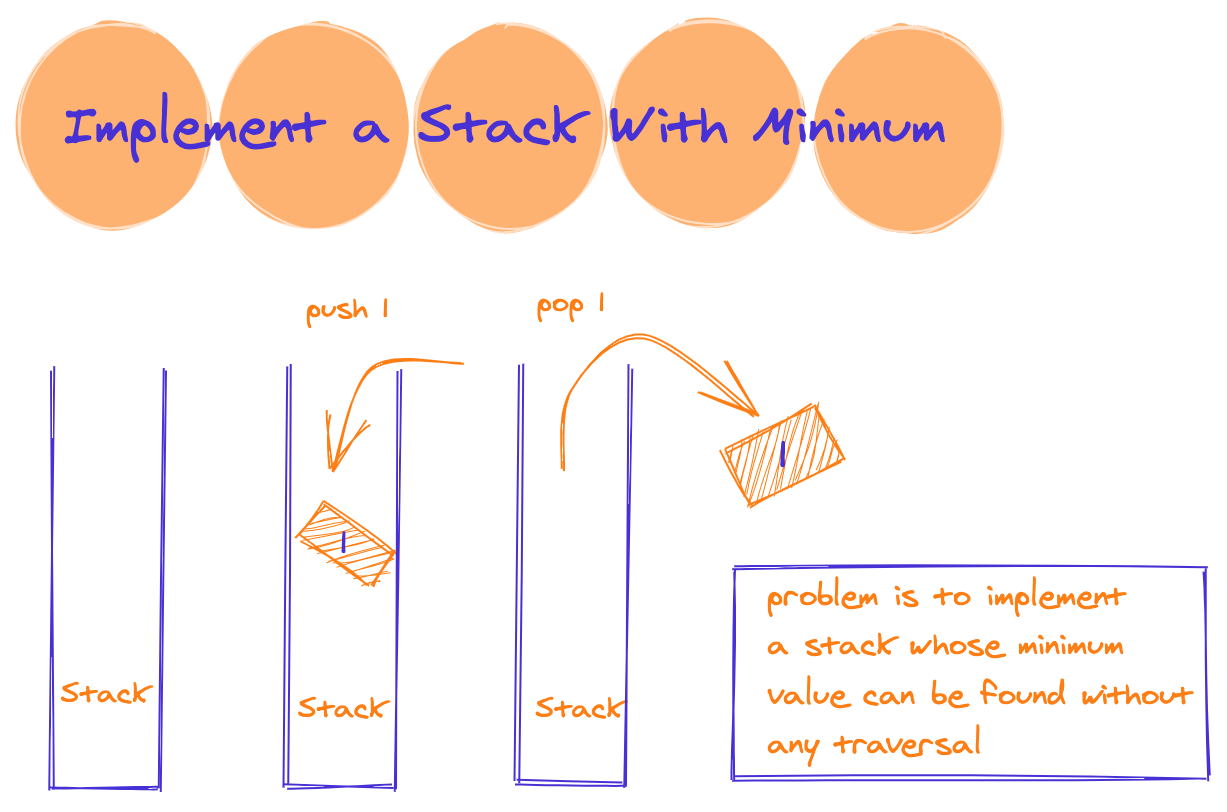
How would you do it, and can you implement it via a MinStack class? The class should have the following methods. Work off this skeleton:
class MinStack {
  constructor() {
  }

  push(val) {
  }

  pop() {
  }

  peek() {
  }

  min() {
  }
}
Can you do call min() and retrieve it in O(1) time?
Constraints
- Total number of operations in the stack <=
100000 - The values will be in the range
-1000000000and1000000000 - Expected time complexity : O(1)
- Expected space complexity : O(n)
```js
class MinStack {
  constructor() {
  }

  push(val) {
  }

  pop() {
  }

  peek() {
  }

  min() {
  }
}
```
```java
class MinStack {
    private Stack<Integer> stack;
    private Stack<Integer> minStack;

    public MinStack() {
        stack = new Stack<Integer>();
        minStack = new Stack<Integer>();
    }

    public void push(int val) {
        stack.push(val);
        if (minStack.isEmpty() || val <= minStack.peek()) {
            minStack.push(val);
        }
    }

    public void pop() {
        if (!stack.isEmpty()) {
            int value = stack.pop();
            if(value == minStack.peek()){
                minStack.pop();
            }
        }
    }

    public int peek() {
        return stack.peek();
    }

    public int min() {
        return minStack.peek();
    }
}

public class Main {
    public static void main(String[] args) {
        MinStack minStack = new MinStack();
        minStack.push(-2);
        minStack.push(0);
        minStack.push(-3);
        minStack.min();
        minStack.pop();
        minStack.peek();
        minStack.min();
    }
}
```
```javascript
class MinStack {
  constructor() {
    this.stack = [];
    this.minStack = [];
  }

  push(val) {
    this.stack.push(val);
    if (this.minStack.length === 0 || val <= this.minStack[this.minStack.length - 1]) {
      this.minStack.push(val);
    }
  }

  pop() {
    const val = this.stack.pop();
    if (val === this.minStack[this.minStack.length - 1]) {
      this.minStack.pop();
    }
  }

  peek() {
    return this.stack[this.stack.length - 1];
  }

  min() {
    return this.minStack[this.minStack.length - 1];
  }
};
```
```python
class MinStack:

    def __init__(self):
        self.stack = []
        self.minStack = []

    def push(self, val):
        self.stack.append(val)
        if len(self.minStack) == 0 or val <= self.minStack[-1]:
            self.minStack.append(val)

    def pop(self):
        val = self.stack.pop()
        if val == self.minStack[-1]:
            self.minStack.pop()

    def peek(self):
        return self.stack[-1]

    def min(self):
        return self.minStack[-1]

minStack = MinStack()
minStack.push(-2)
minStack.push(0)
minStack.push(-3)
minStack.min()
minStack.pop()
minStack.peek()
minStack.min()
```
```cpp
#include <stack>

class MinStack {
    std::stack<int> stack, minStack;
public:
    MinStack() = default;

    void push(int val) {
        stack.push(val);
        if (minStack.empty() || val <= minStack.top()) {
            minStack.push(val);
        }
    }

    void pop() {
        if(stack.top() == minStack.top()) minStack.pop();
        stack.pop();
    }

    int peek() {
        return stack.top();
    }

    int min() {
        return minStack.top();
    }
};

int main() {
    MinStack minStack;
    minStack.push(-2);
    minStack.push(0);
    minStack.push(-3);
    minStack.min();
    minStack.pop();
    minStack.peek();
    minStack.min();
}
```
```csharp

public class MinStack
{
    private Stack<int> stack;
    private Stack<int> minStack;

    public MinStack()
    {
        stack = new Stack<int>();
        minStack = new Stack<int>();
    }

    public void Push(int val)
    {
        stack.Push(val);
        if (!minStack.Any() || val <= minStack.Peek())
        {
            minStack.Push(val);
        }
    }

    public void Pop()
    {
        int value = stack.Pop();
        if (value == minStack.Peek())
        {
            minStack.Pop();
        }
    }

    public int Peek()
    {
        return stack.Peek();
    }

    public int Min()
    {
        return minStack.Peek();
    }
}

public class Program
{
    public static void Main(string[] args)
    {
        MinStack minStack = new MinStack();
        minStack.Push(-2);
        minStack.Push(0);
        minStack.Push(-3);
        minStack.Min();
        minStack.Pop();
        minStack.Peek();
        minStack.Min();
    }
}
```
```go
package main

import "fmt"

type MinStack struct {
	stack []int
	minStack []int
}

func Constructor() MinStack {
	return MinStack{}
}


func (this *MinStack) Push(val int)  {
	this.stack = append(this.stack, val)
	if len(this.minStack) == 0 || val <= this.minStack[len(this.minStack)-1] {
		this.minStack = append(this.minStack, val)
	}
}

func (this *MinStack) Pop()  {
	val := this.stack[len(this.stack)-1]
	this.stack = this.stack[:len(this.stack)-1]

	if val == this.minStack[len(this.minStack)-1] {
		this.minStack = this.minStack[:len(this.minStack)-1]
	}
}

func (this *MinStack) Peek() int {
	return this.stack[len(this.stack)-1]
}

func (this *MinStack) Min() int {
	return this.minStack[len(this.minStack)-1]
}

func main() {
	minStack := Constructor()
	minStack.Push(-2)
	minStack.Push(0)
	minStack.Push(-3)
	fmt.Println(minStack.Min())
	minStack.Pop()
	fmt.Println(minStack.Peek())
	fmt.Println(minStack.Min())
}
```
CONTINUE WITH ALGODAILY PREMIUM
Keep going with the complete tutorial.
Unlock the remaining explanations and exercises, alongside the full learning library.
Explore Premium →